Running a school in Dublin is not just about lesson plans and timetables. It is also about making sure every student walks into a clean, safe, and healthy building each morning. Dublin's primary and secondary schools serve hundreds of children every single day and those children share desks, toilets, corridor railings, and canteen surfaces in ways that make consistent hygiene non-negotiable.
A well-structured school cleaning checklist is the single most practical tool a school manager, caretaker, or school cleaning services Dublin provider can use to make sure nothing is missed. Without one, cleaning becomes reactive rather than systematic toilets are cleaned because they smell, not because they were due for attention three hours ago. Classrooms are wiped down when someone notices a mess, rather than because a schedule says it is time.
This guide breaks down exactly what a complete school cleaning checklist for Dublin schools should include room by room, task by task, and frequency by frequency. Whether your school manages cleaning in-house or contracts a professional cleaning company, this checklist gives you a clear baseline to work from.
Why Dublin Schools Need a Structured Cleaning Checklist
Schools are among the highest-traffic environments of any building type. A primary school with 300 students and 25 staff members may see every surface in its corridors and classrooms touched dozens of times before midday. Without a structured approach to cleaning, cross-contamination between high-touch surfaces becomes a genuine health risk not a theoretical one.
The Health Service Executive (HSE) publishes national cleaning standards that establish the minimum hygiene requirements for Irish public facilities. While these standards were developed primarily for healthcare settings, the core principles risk classification of areas, frequency scheduling, and touch-point priority apply directly to educational environments where vulnerable populations (children) congregate in shared spaces daily.
In practical terms, a school without a checklist is a school where cleaning is inconsistent. A school with a checklist is a school where every cleaner knows exactly what to do in every room, every day regardless of who is on shift. For Dublin school managers, that consistency is the difference between a hygiene standard that holds and one that drifts.
A checklist also creates accountability. When cleaning tasks are documented and signed off, a school can demonstrate to parents, inspectors, and staff that hygiene maintenance is taken seriously. That paper trail matters, particularly in the wake of illness outbreaks or during HSE review periods.
Before You Start: Understanding Cleaning Frequency Levels
Not every surface in a school needs the same cleaning attention every day. A well-designed school cleaning checklist uses frequency tiers to allocate cleaning resources where they matter most:
Daily Cleaning Tasks
These are the surfaces and areas that are touched repeatedly throughout the school day by multiple students and staff members. Daily cleaning is non-negotiable for these areas because contamination accumulates within hours.
- Toilet and washroom facilities all fixtures, floors, and door handles
- Classroom desks and chairs wiped with a disinfectant solution
- Door handles, light switches, and push plates throughout the building
- Canteen tables, chairs, and food preparation surfaces
- Corridor floors swept and mopped
- Waste bins emptied and relined
- Stair handrails and lift buttons where applicable
Weekly Cleaning Tasks
These are areas that receive moderate use or where contamination builds more slowly. Weekly attention maintains standards without overallocating cleaning time.
- Classroom windows interior surfaces wiped down
- Skirting boards and door frames dusted and spot cleaned
- Gym and sports hall floors deep mopped and disinfected
- Library shelving and surfaces dusted
- Staff room appliances wiped down externally
- Canteen floor deep scrubbed beyond the daily mop
- Storage room floors swept
Monthly and Termly Deep Cleaning
These tasks address areas where dirt accumulates over longer periods. They are typically scheduled during school holidays or early mornings when the building is unoccupied.
- Full carpet extraction or hard floor stripping and resealing in corridors
- Ceiling vents, air conditioning grilles, and high-level dust removal
- Gym equipment deep cleaned and sanitised
- All exterior-facing windows cleaned inside and out
- Kitchen deep clean including inside appliances and behind equipment
- Upholstery cleaning in staff rooms and reception areas
Pro Tip
Dublin schools should schedule their full deep clean to coincide with mid-term breaks or the summer close-down period. This allows cleaners to access every area without disruption and gives surfaces adequate drying and airing time before students return.
Room-by-Room School Cleaning Checklist for Dublin Schools
Classrooms
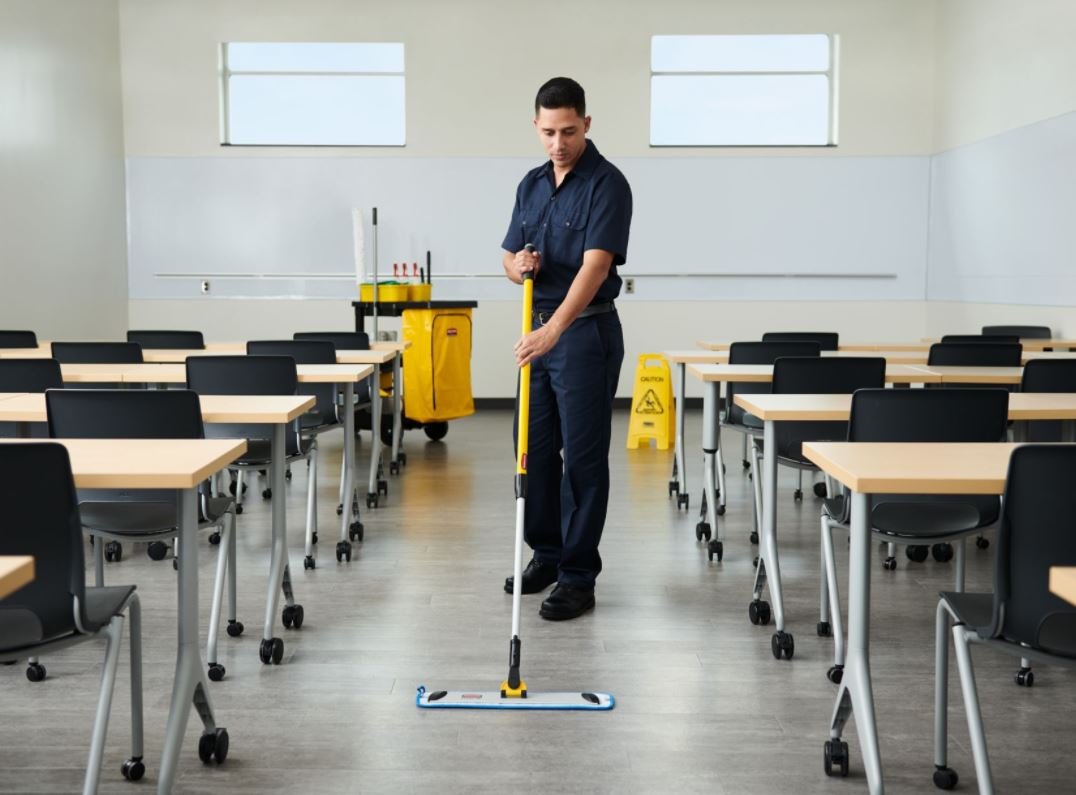
Classrooms are where students spend the majority of their day. Every desk, chair, and shared resource is a potential transfer point for bacteria and viruses. The classroom cleaning checklist should be completed after each school day.
Daily tasks:
- Wipe all desk surfaces with a disinfectant-grade cloth front, back, and sides
- Clean chair seats and backs where students have direct contact
- Disinfect the teacher's desk and all shared equipment including keyboards, mice, and projector remotes
- Empty and reline all waste bins place outside for collection
- Sweep or vacuum the floor thoroughly, paying attention to under-desk areas
- Damp mop hard floors or vacuum carpeted areas
- Clean the interactive whiteboard tray and surrounding area
- Spot clean any marks on walls, windows, or door surfaces
- Disinfect door handles on both sides
Weekly tasks:
- Wipe down window sills and interior window glass
- Clean light switches and plug socket covers
- Dust shelving, storage units, and display board frames
- Disinfect cubbyholes and shared storage areas
Toilets and Washroom Facilities
School toilets are the highest-risk area in any educational building. They require cleaning at minimum twice daily once before school starts and once at midday with a full clean after school hours. In Dublin schools with 300 or more students, a three-times-daily schedule is strongly recommended.
Each clean should include:
- Sanitise all toilet bowls inside and under the rim using a disinfectant cleaner leave to dwell before scrubbing
- Wipe toilet seat tops and bottoms with a fresh disinfectant cloth never reuse cloths between cubicles
- Disinfect flush handles and push buttons
- Clean all washbasin surfaces, taps, and soap dispensers
- Wipe cubicle door handles, locks, and hinges
- Clean mirrors streak free
- Refill soap, paper towel, and toilet roll dispensers before they run out
- Sweep and damp mop the floor with a disinfectant solution
- Empty sanitary waste bins and replace liners in each cubicle
- Check and clean any blocked or slow floor drains
Pro Tip
In Dublin's primary schools, toilet cleaning logs posted inside the washroom door serve two purposes: they hold cleaners accountable to their schedule and they reassure parents and visiting inspectors that hygiene standards are actively maintained.
Clean 4 U provides and manages cleaning logs as part of our school cleaning contracts.
Corridors and Entrance Areas
The main entrance is the first impression every visitor, parent, and inspector receives of your school. Corridors carry the highest foot traffic of any non-classroom area and collect dirt, wet footwear residue, and outdoor debris every day.
Daily tasks:
- Sweep or vacuum all corridor floors from entrance to furthest wing
- Damp mop hard floors use a neutral pH cleaner to protect floor finish
- Clean main entrance door glass panels inside and out
- Wipe reception desk surfaces and disinfect any shared pens or touch-screen panels
- Disinfect all corridor handrails and balustrades
- Remove any tracked-in mud, leaves, or debris from entrance matting
- Empty corridor waste bins
Weekly tasks:
- Deep scrub corridor floor along edges and corners where mops cannot reach
- Clean all corridor noticeboards and surrounding wall areas
- Wipe locker exteriors and handles where applicable
Canteen and Kitchen Areas
School canteens in Dublin that prepare or serve food are subject to food hygiene regulations under European Communities (Hygiene of Foodstuffs) Regulations. Even schools that serve only reheated or pre-packaged food must maintain kitchen surfaces and equipment to a food-safe standard. Cleaning here is not optional it is legally required.
Daily canteen cleaning tasks:
- Clean and disinfect all food preparation surfaces before and after each meal service
- Wipe down all serving counters, sneeze guards, and tray slides
- Clean and disinfect all canteen tables and chairs after each sitting
- Sweep canteen floor between sittings damp mop after the final sitting
- Clean and disinfect all kitchen appliances externally microwave interiors daily
- Wash all utensil trays, serving equipment, and food contact surfaces
- Empty all kitchen waste bins and food waste containers replace liners
- Clean grease filter covers externally
Weekly kitchen tasks:
- Deep clean the interior of all ovens, microwaves, and heated display units
- Clean behind and underneath all fixed kitchen appliances
- Descale kettles, urns, and water dispensers
- Wash out waste bins with disinfectant solution before relining
Staff Rooms and Administration Offices
Staff rooms and offices receive lower student traffic but are still shared spaces where cross-contamination can occur. They also tend to harbour kitchen appliance buildup that is easily overlooked in a school cleaning schedule.
Daily tasks:
- Wipe all desk surfaces and telephone handsets
- Disinfect shared keyboard and mouse surfaces
- Clean and disinfect the sink, tap, and surrounding surfaces
- Wipe kettle and microwave exteriors
- Sweep or vacuum floor and damp mop
- Empty all waste bins
Weekly tasks:
- Clean inside the microwave and any food-contact appliances
- Wipe down all chairs and upholstered seating with appropriate cleaner
- Clean fridge door handles and exterior surfaces
Gym and Sports Facilities
Gym halls and sports changing rooms create specific hygiene challenges. Body contact with floors, shared equipment, and changing room benches makes this area a high-risk zone for skin infections and respiratory illness if not properly maintained.
Daily tasks:
- Sweep gym hall floor thoroughly remove all debris before mopping
- Damp mop gym floor with a disinfectant-grade cleaner approved for sports surfaces
- Disinfect all shared sports equipment handles and grip surfaces
- Clean and disinfect all changing room benches and locker handles
- Disinfect shower areas floor, walls, and fittings
- Clean and disinfect toilet fixtures within changing rooms
- Empty all waste bins in changing areas
Weekly tasks:
- Deep clean gym floor edges and corners
- Wipe down wall-mounted equipment and storage rack surfaces
- Clean interior of all lockers where accessible
Colour-Coded Cleaning: Why Dublin Schools Should Implement It
One of the most important hygiene protocols a Dublin school can adopt and one that professional cleaning companies use as standard is colour-coded cleaning equipment. The principle is simple: each area of the school is assigned a specific colour of cloth, mop head, and bucket. Cleaning tools from one area are never used in another.
The standard colour-coding system used in Irish commercial cleaning is:
- Red toilets and washroom floors
- Yellow washbasin surfaces, sinks, and urinals
- Blue general surfaces including classrooms, offices, and corridors
- Green food preparation and canteen surfaces
Without colour-coding, a mop used to clean a toilet floor may later be used on a canteen floor. A cloth used to wipe a washbasin may be rinsed and used on a classroom desk. Colour-coding eliminates this cross-contamination risk at the equipment level, regardless of who is cleaning.
This is a standard that Clean 4 U applies across all of our commercial cleaning services contracts in Dublin, including our school cleaning programme. It is an inexpensive protocol that makes a significant difference to the hygiene outcome of any cleaning regime.
Pro Tip
When briefing in-house cleaning staff or reviewing a cleaning contractor's methods, always ask specifically about colour-coded equipment. A cleaning company that cannot explain their colour-coding protocol clearly is a company that may not be applying it consistently.
Touch-Point Cleaning: The Most Overlooked Part of Any School Checklist
Standard cleaning wiping desks, mopping floors, cleaning toilets addresses the surfaces that are most visibly dirty. Touch-point cleaning addresses the surfaces that carry the most microbiological risk, regardless of whether they look dirty.
A touch point is any surface that is frequently contacted by multiple people throughout the day. In a school setting, touch points are the primary transmission pathway for respiratory viruses, gastrointestinal bacteria, and skin infections. They must be disinfected daily as a minimum and in high-traffic schools, twice daily during illness season.
The complete touch-point checklist for Dublin schools:
- All interior and exterior door handles every door in the building
- Light switches in every classroom, corridor, toilet, and office
- Stair handrails from ground floor to top floor
- Lift buttons and door panels where applicable
- Reception desk surfaces and signing-in pads
- Shared computer keyboards and mice in every room
- Telephone handsets in office and staff areas
- Canteen tray slides, serving tongs, and condiment dispensers
- Water fountain push pads and tap levers
- Photocopier and printer control panels
- Interactive whiteboard stylus holders and screens
- Locker handles in changing rooms and storage areas
Many school cleaning schedules include a general wipe-down of classrooms and a thorough toilet clean but leave touch points unaddressed. The result is that the visually clean school may still be a microbiologically high-risk environment. Touch-point cleaning is the element that bridges that gap.
In-House Cleaning vs. Professional School Cleaning in Dublin: What Schools Need to Know
Many Dublin schools rely on a combination of a part-time caretaker or cleaner employed directly by the school and a contracted professional cleaning company for scheduled deep cleans or holiday cleans. Others contract their full cleaning programme to a specialist provider. Both approaches can work the key is understanding what each requires.
In-House Cleaning: What It Can and Cannot Cover
A dedicated school caretaker or in-house cleaner with a well-structured checklist can maintain daily cleaning standards effectively, provided they have the right equipment, enough hours, and clear guidance on products and procedures. The limitations of in-house cleaning typically emerge in:
- Deep cleaning tasks that require specialist equipment carpet extraction, floor stripping, high-level cleaning
- Holiday period deep cleans that require a full team rather than one or two staff members
- Specialist tasks like window cleaning at height or graffiti removal
- Consistent use of correct colour-coded equipment and disinfectant protocols without formal training
What a Professional School Cleaning Company Provides
A professional school cleaning services Dublin provider brings trained staff, specialist equipment, and structured quality control to the cleaning programme. At Clean 4 U, our school cleaning contracts include:
- Colour-coded equipment and professional-grade disinfectants approved for use in educational environments
- Background-verified cleaning staff with training in school-specific hygiene protocols
- Flexible scheduling early morning, evening, and holiday deep clean slots
- Regular communication with school management to flag any hygiene issues identified during cleaning
- Cleaning logs and completion records maintained for every visit
For schools that currently manage cleaning in-house and are considering a review of their programme, our team is happy to carry out a free site assessment. You can reach us through our office cleaning Dublin and school cleaning enquiry page, or call us directly at 1800 938 831.
Frequently Asked Questions
At minimum, Dublin schools should have daily cleaning of high-risk areas including toilets, canteens, and classrooms, combined with a professional deep clean at each mid-term break and a full building deep clean at the summer close-down. Schools with 300 or more students benefit from twice-daily toilet cleaning during term time, particularly between October and March when respiratory illness rates are higher.
Dublin schools should use cleaning products that are EN-certified disinfectants these carry a European standard certification confirming their effectiveness against bacteria and viruses. Products should be free from bleach in areas where children are present during cleaning, and all chemicals should be stored in locked, ventilated storage separate from any food areas. Eco-certified products are increasingly preferred in Irish schools as they reduce chemical exposure for students and staff.
Touch-point cleaning is the systematic disinfection of surfaces that are frequently contacted by multiple people door handles, light switches, handrails, keyboard surfaces, and similar items. These surfaces carry significantly higher levels of microbial contamination than general surfaces because they are touched repeatedly throughout the day. In a school with hundreds of students, touch-point cleaning is the most direct way to reduce the transmission of respiratory viruses and gastrointestinal bacteria.
Dublin schools have specific cleaning requirements that differ from standard commercial cleaning background-checked staff, child-safe cleaning products, flexible out-of-hours scheduling, and familiarity with educational facility hygiene protocols. A specialist school cleaning provider will have systems in place for all of these requirements. A general commercial cleaning company may be able to service a school but should be asked specifically about their experience with educational facilities before being contracted.
School cleaning costs in Dublin vary based on the size of the building, the number of cleaning hours required daily, and the scope of services included. Smaller primary schools may have a daily cleaning contract starting from around €80 to €120 per visit, while larger secondary schools with specialist facilities such as gyms and canteens will have higher costs. Clean 4 U provides free site assessments and transparent quotes tailored to each school's specific requirements.
A complete school toilet cleaning checklist should cover: all toilet bowls cleaned and disinfected with appropriate dwell time, toilet seats sanitised on both surfaces, flush handles and push buttons disinfected, washbasin surfaces and taps cleaned, cubicle door handles and locks disinfected, mirrors cleaned, all dispensers refilled before they empty, floor swept and damp mopped with disinfectant solution, and sanitary waste bins emptied and relined. In Dublin schools, a completed cleaning log should be posted inside the toilet area for each clean.
Colour-coded cleaning equipment is not a legal requirement in Irish schools, but it is a best-practice standard recommended by professional cleaning bodies and widely adopted by reputable commercial cleaning companies. It prevents cross-contamination between high-risk areas such as toilets and food preparation surfaces. Schools that contract a professional cleaning provider should confirm that colour-coding is part of their standard operating procedure.
The most effective deep clean scheduling for Dublin schools aligns with mid-term breaks in October, February, and Easter, as well as the summer close-down in June. These periods allow cleaners to access all areas without disrupting lessons, and give surfaces sufficient drying time before students return. Holiday-period deep cleans should cover high-level dusting, floor stripping or extraction, gym equipment sanitisation, and full kitchen deep cleaning.
The Bottom Line for Dublin School Managers
A school cleaning checklist is not a document that gets written once and filed away. It is a working tool that should be reviewed at the start of each term, updated when room usage changes, and checked against actual cleaning practice regularly. The schools in Dublin that maintain consistent hygiene standards are the ones that treat cleaning as a structured programme rather than a reactive response to visible mess.
The checklist in this guide covers the full range of what a Dublin primary or secondary school cleaning programme should include from daily touch-point disinfection to termly deep cleans, from classroom desks to gym floors, from canteen compliance to colour-coded equipment protocols. Use it as a baseline and adapt it to your school's specific layout and schedule.
If your school is reviewing its current cleaning arrangements or looking for a specialist school cleaning services Dublin provider, Clean 4 U works with primary and secondary schools across Dublin. We provide fully managed cleaning contracts, background-verified staff, eco-friendly products, and flexible scheduling that works around your school timetable.
To arrange a free site assessment or request a cleaning quote, contact us today or call 1800 938 831. We look forward to helping you build a cleaner, healthier learning environment for every student and staff member in your school.